Growing a LinkedIn Profile for Founders and Consultants
A profile that turns visitors into conversations, a weekly routine that fits around client work, and what to measure when your goal is meetings and not likes.
If you run a company or sell your own expertise, LinkedIn has one job: getting the right people to think of you when they have a problem you solve. Follower counts are a side effect. A consultant with 2,400 followers who are all heads of operations at mid-sized logistics firms will get more work than an account with 60,000 strangers.
This guide is for people with a full diary. It should take about two hours a week once your profile is done.
Fix the profile first
Your posts send people to your profile, and your profile decides whether they contact you. Rewrite it before you post anything else, working through it as a stranger would see it.
Headline
Say who you help and with what. "Founder at Northline" tells a visitor nothing. "I help logistics firms cut failed deliveries" tells them whether to keep reading. Your headline appears next to every comment you leave, so it's the piece of copy you'll use most.
Photo and banner
Use a recent, well-lit photo with your face filling most of the frame. Use the banner for a plain statement of what you do, plus a proof point if you have one.
About section
Write it to the client. Start with the problem they have, then say how you help, name two or three results with numbers you can defend, and finish by telling them how to contact you. Put your email in there. Forcing busy people through a form loses them.
Featured section
Pin your best case study, one strong post, and a booking link. That's your shop window.
Experience and recommendations
Write what you did and what changed, in numbers. Ask three happy clients for recommendations this week, and give them a specific prompt, such as "could you mention how the rollout went?" Specific recommendations read better and take them less time to write.
Decide who you're talking to
Write one sentence describing your ideal client: role, company size, sector and the problem that keeps them up. Every post should be useful to that person. This feels limiting, and it will do more for you than any tip on this page, since a post that interests your exact buyer is worth more than a viral one aimed at everybody.
Then build the audience on purpose. Send connection requests to people who fit, with a one-line note about something specific. LinkedIn caps connections at 30,000, so most people won't hit a limit, but it's worth keeping your list relevant, because connections shape what the feed shows you and who sees your posts.
A weekly routine that fits around client work
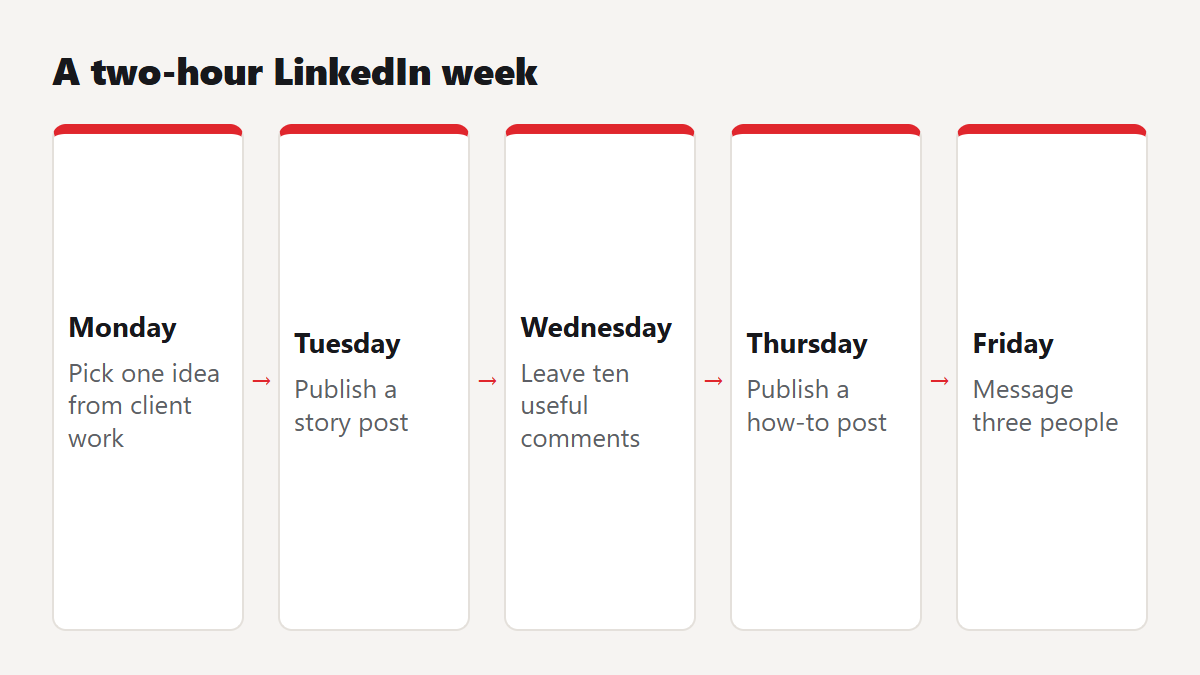
Two posts a week is plenty if you do them well. Consistency over 6 months counts for more than a burst of daily posting that stops in week three.
Comments are the underrated part of this routine. Leaving ten thoughtful comments on posts by your ideal clients and the people they follow gets your face and headline in front of exactly the right people. Add something: a number, a counterexample, a question. "Great post" does nothing for anyone.
What founders and consultants should post
You have material that nobody else has, because you do the work. Each week, ask what happened that a client would want to hear about.
- Client stories, anonymised if needed. Problem, what you tried, what happened, what you'd do differently.
- Mistakes. "We lost a $40,000 contract because of one line in the proposal" gets read by everybody who's ever written a proposal.
- Opinions on a common practice in your field, with a reason. Mild disagreement starts conversations.
- Numbers from your own work. Costs, timelines, before and after.
- Short how-tos. One problem, the steps, one example.
- Behind-the-scenes founder decisions: a hire, a price change, a product you killed.
Open with a line that makes your buyer stop, since LinkedIn cuts posts off after a couple of lines. Write in short paragraphs. Put your links in comments or keep them out if you've seen reach fall when you include them, and judge that from your own analytics. Our LinkedIn reach tips cover post formats in more detail.
Turning attention into conversations
This is the step that most people skip. Reach doesn't produce revenue until someone talks to you. Every week, look at who liked, commented or viewed your profile. If they fit your client sentence, send a short message that refers to what they engaged with and asks one easy question. Don't pitch. "Saw you commented on the carrier post. Is that a live problem for you at the moment?" is enough.
Keep a simple list of these people. If you hold 3 good conversations a week for a year, that's about 150. Most of your work will come from that list, and from people those contacts recommend.
What to measure
| Measure | Why | How often |
|---|---|---|
| Profile views from your target roles | Tells you whether the right people are curious | Weekly |
| Comments from people who fit | Better than total likes | Weekly |
| Conversations started | The number that leads to work | Weekly |
| Calls booked and proposals sent | The result of all this | Monthly |
| Engagement rate | Spots posts that work | Monthly |
Our free LinkedIn engagement calculator does that last one for you, and the LinkedIn tools hub has others.
Should you buy LinkedIn followers?
We sell LinkedIn followers, likes and connections, and for this audience our answer is mostly no. LinkedIn is the smallest of worlds. Your buyers are looking at your profile to decide whether to trust you with a contract, and if the follower count is 40,000 while posts collect 3 likes, an experienced buyer notices. Fake indicators used to misrepresent your importance for a commercial purpose are also what the FTC rule addresses in the US, and a consultant selling services on the strength of an inflated profile fits that description uncomfortably well.
The one case worth thinking about is a new company page sitting at 11 followers, where a small top-up is a matter of not looking abandoned, and you aren't using the figure to claim anything. Even then, invite your staff, clients and suppliers first, because they're the audience that's useful. Keep any order small, and don't mention the number in your sales material.
Your time is better spent on the two hours a week above. Start with the profile today, then pick the first client story you'll post on Tuesday.
Real, paced delivery for Instagram, TikTok, YouTube and 20+ more platforms — with a free 2-year refill on every order.