How to Check If an Influencer's Followers Are Fake Before You Pay Them
A six-step audit for brands: engagement, comment quality, growth history, audience location and what to ask the creator, plus how to read the results fairly.
You've found a creator with 80,000 followers and a rate card to match. Before you send money, spend 20 minutes finding out how many of those followers exist in any useful sense. It's a strange thing for a follower seller to tell you, though we'd rather you had this information than not. We publish a free fake follower checker, and you may as well know how to use it.
This guide is for small brands and marketers. If you just want to look over an account for your own curiosity, our shorter post on spotting fake followers may be enough.
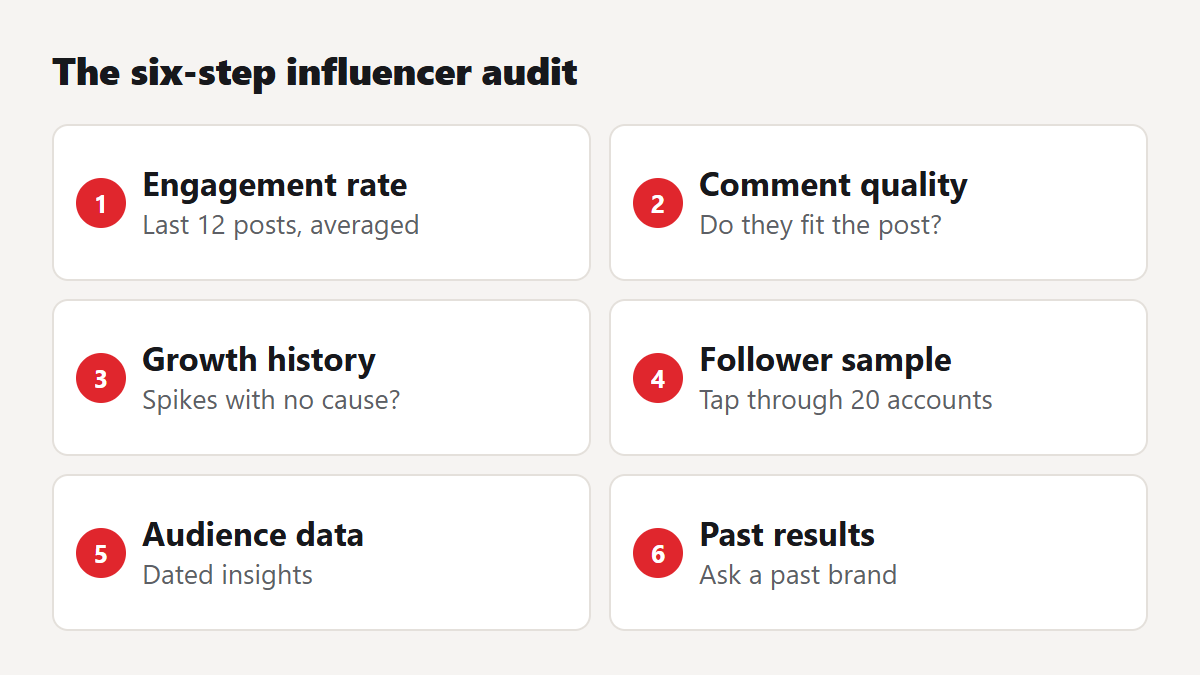
Step 1: work out the engagement rate
Add up likes and comments on the last 12 posts, leave out anything sponsored or unusually viral, then take the average and divide by followers. Our free Instagram engagement calculator will do it for any public profile, and there are versions for TikTok and YouTube.
The ranges in our engagement rate guide give you a benchmark: 1.5 to 3.5% is typical for 10,000 to 100,000 followers, for example. A rate well below that deserves a closer look. So does one far above it, since a 25% rate on 200,000 followers can mean that the engagement itself has been bought.
Step 2: read the comments
This is the check that software can't do as well as you. Open five recent posts and read 20 comments on each. Good comments respond to what's in the post: a question about the recipe, a reaction to the story, a friend being tagged. Warning signs are:
- Single emojis and "nice pic!" comments that could sit under any post at all.
- The same few accounts commenting on every post within minutes, which can point to an engagement pod.
- Comments in languages that don't match the creator's audience.
- Promotional comments from accounts that sell things.
- Almost no replies from the creator.
Step 3: look at the growth history
Real audiences grow in waves around good posts. Sudden jumps that have no viral post behind them suggest a purchase, particularly if they're followed by a slow leak as those followers disappear. Third-party analytics tools show this over time. Our account audit tool and comparison tool are free places to begin, and you can also ask the creator for a screenshot of their follower graph from Insights.
Keep things fair, though. A spike can have an innocent cause, like a press mention, a viral Reel or a shout-out from a bigger account. Ask what happened that week.
Step 4: sample the followers
Open the follower list and tap through 20 accounts at random. If the list is hidden, look at people who've liked recent posts. Mark any with no profile picture, no posts, gibberish names or following thousands of accounts while having few followers. A few of these are normal on every account, including yours. If half your sample looks like that, you have an answer.
Run the handle through our fake follower checker as well, plus the TikTok and X versions. Treat its score as an estimate, because it works from public signals like follower ratios and engagement. It can't see inside the account, and no outside tool can.
Step 5: ask for audience data
Any professional creator can show you their insights. Ask for screenshots or a short screen recording of these, dated within the past week:
- Top countries and cities.
- Age and gender split.
- Reach and views on the last five posts.
- Story views, which are hard to inflate and show who's paying attention.
- The share of reach that comes from followers and from non-followers.
Check that the numbers fit your brief. If you sell in Germany and 70% of the audience is elsewhere, the audience may be real and still useless to you. A screen recording is harder to doctor than a screenshot. Hesitation about sharing data isn't proof of anything, but a refusal is a reason to pick someone else.
Step 6: ask for past results
Ask for two or three examples of past brand work, with results: clicks, discount code uses, sales or sign-ups. Then, if you can, contact one of the brands. A short message asking "would you work with them again?" tells you more than a media kit.
How to read the results
| What you found | What to do |
|---|---|
| Normal engagement, good comments, audience matches your brief | Go ahead and negotiate. |
| Low engagement, good comments | Possibly an older or broad audience. Pay on results, or reduce the rate. |
| A few odd followers, everything else fine | Normal. All accounts attract some bots. |
| Spikes with no cause, generic comments, odd audience location | Walk away, or ask direct questions first. |
| Won't share data | Walk away. |
Don't punish a creator for bots they didn't buy. Spam accounts follow popular profiles without anybody asking them to, and the FTC's 2024 rule doesn't make you liable if you unknowingly work with an influencer who has fake followers, according to one law firm's analysis. You're looking for a pattern, and one signal isn't a pattern.
Protect yourself in the deal
- Start with a single small paid post before you agree a long campaign.
- Give each creator a unique link or discount code, so that you can track sales.
- Tie part of the fee to performance, such as a bonus for reach or sales.
- Put the audience figures they gave you in the contract, along with a clause that says they haven't bought followers or engagement.
- Ask for insights from the sponsored post within seven days of it going live.
- Make sure the post is labelled as paid. Disclosure rules apply to you as well as the creator.
Bigger isn't better
A small creator with 6,000 engaged followers in your exact niche is often a better buy than a large account with a general audience. Their rate is lower, they usually reply to their followers, and an audit takes less time. For a guide to fair rates, see how much influencers should charge, and test a figure in the pricing calculator.
If you've done this audit a few times, it gets quick. Open the profile, run the calculator, read the comments, ask for insights. Twenty minutes of checking is cheap next to a $2,000 post that nobody sees. All the tools named here are free and need no sign-up, and they're listed in our tools hub.
Real, paced delivery for Instagram, TikTok, YouTube and 20+ more platforms — with a free 2-year refill on every order.