Spotify Promotion for Independent Artists: A Release Plan That Holds Up
A four-week release plan for independent artists, the 1,000-stream royalty rule, and a frank look at what artificial streams can cost you with your distributor.
Getting a song onto Spotify is the easy part. A distributor will do that for a small fee, and then the track sits among millions of others with nobody listening. Promotion is what you do in the weeks around release day, and most of what works costs time more than money.
We sell Spotify services, so we have an interest here. We also think artists should know what can go wrong before they spend anything, and music has a risk that followers on Instagram don't have. That part comes first.
The rules you need to know first
The 1,000-stream threshold
Since April 1, 2024, a track needs at least 1,000 streams in the previous 12 months to earn recorded royalties on Spotify. Below that, the master side of the track earns nothing. Spotify has said it will still pay publishing royalties on those tracks. For a small artist this changes the arithmetic: a deep catalogue of songs with 300 plays each earns less than a few songs that clear the line.
Penalties for artificial streaming
Spotify also announced that it would charge labels and distributors per track when it detects flagrant artificial streaming. Spotify hasn't published the amount, and press reports put it at around €10 per track, for tracks where 90% or more of the streams are judged to be artificial.
That charge lands on your distributor, and a distributor can pass it to you. Distributors can also take a release down or close an account, and that's the outcome to think hard about, because it can take your whole catalogue with it. Streams from bots or paid listening schemes are what the policy targets. Spotify doesn't tell anyone exactly how it decides.
So here is our plain advice: don't buy plays for a release that your career depends on, and read your distributor's terms before you buy anything for any track. If you've signed with a label, ask them first. We would sooner lose that sale than have you lose a catalogue.
A four-week release plan
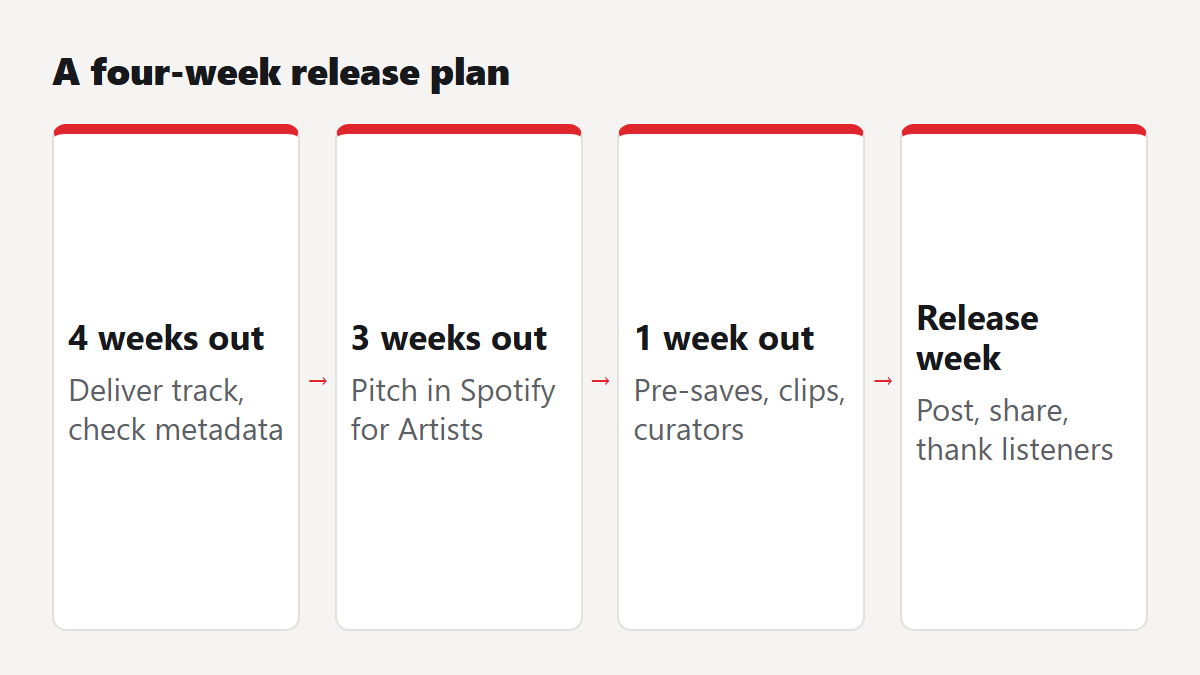
Four weeks out: deliver the track
Upload to your distributor at least four weeks ahead. The extra time gives you room to fix metadata errors, and you need the track in the system before you can pitch it. Check your artist name, songwriter credits and cover art. Claim your Spotify for Artists profile if you haven't already, add an up-to-date photo and write a bio that says who you are and what you sound like.
Three weeks out: pitch it
Spotify for Artists lets you pitch one unreleased song to the editorial team. You need to submit at least seven days before release, and earlier is better. Fill in every field: genre, mood, instruments, the story behind the track and your marketing plans. Editors read thousands of these, so name something specific, like the local show you're playing or the sync placement you've confirmed. Even when a pitch doesn't reach an editorial playlist, a pitched track tends to show up in your followers' Release Radar, which is one reason followers are worth having.
One week out: warm up your listeners
Share a pre-save link in your bio and email list. Cut three or four vertical clips of the catchiest 15 seconds, and post them on TikTok, Reels and Shorts. Send the track to small independent playlist curators in your genre, with a short personal note. Check that they're real curators first: a playlist with 40,000 followers and almost no monthly listeners attributed to it is a warning sign, and so is anyone who guarantees placement for a fee. Those lists are a common source of the very streams that get artists penalised.
Release week: be everywhere your fans are
Post on release morning, go live if you can, and ask people to save the track and add it to their own playlists. Saves and playlist adds are a stronger signal of interest than a passive play. Reply to every comment. Thank the first listeners by name. Write to anyone who already likes your music and ask them directly, because one personal message beats ten posts.
What to do in the month after
A release doesn't end on day seven. Spotify for Artists shows where your listeners come from, so check it weekly. If most plays are coming from one playlist, write to the curator and say thanks. If they're coming from one city, that's your first gig idea. Keep cutting clips from the same song for a few more weeks, since you've spent money on it and most of your audience has only seen it once.
Plan the next release before this one fades. Many independent artists find that releasing a single every six to eight weeks keeps them in followers' Release Radar more often than one album a year. That's a rule of thumb, and it depends on how much music you can finish well.
Where the follower count fits
Numbers on an artist profile do two things. They reassure a visitor that other people have listened, and followers receive your new releases in their feed, if they're listeners. Spotify's system responds to how listeners behave: skips, saves and repeats. A bought number doesn't create that behaviour.
That leaves a narrow place for paid services. If you've decided the risk suits you and your distributor's terms allow it, keep the order small and spread it out. Spotify followers sit further from the artificial-streaming problem than plays do, because a follower isn't a royalty-bearing stream. Plays and monthly listeners carry the most risk. Don't aim any of it at a track you're pitching, and never use it to clear the 1,000-stream line, because that's the kind of pattern the rule was written for.
Refills aren't a shield here either. Our refill policy doesn't apply to content a platform removes or penalises for breaking its rules, and our terms make you responsible for following each platform's rules.
Promotion that costs nothing
- Play live and put a QR code to your Spotify profile on the merch table.
- Collaborate with one artist in your genre. Each of you reaches the other's listeners, and a shared credit links your profiles.
- Build an email list from day one. No algorithm stands between you and those people.
- Answer local radio and college station calls. They still need new music.
- Make a playlist of your influences with your song in it. It's honest, and fans share it.
If you make music you'll also want to read our guide for new artists on SoundCloud, where the rules and the community work differently. For the short clips, our notes on how the TikTok algorithm works will help you choose which 15 seconds to post.
Real, paced delivery for Instagram, TikTok, YouTube and 20+ more platforms — with a free 2-year refill on every order.