How Agencies Can Use Growth Services Without Misleading Clients
Where paid boosts fit in client work, what you must disclose, how to keep records per client, and the jobs an agency should turn down.
If you run a small social media agency or work as a freelancer, a client will ask you about this eventually. "Can't we just buy some followers?" Sometimes you'll wonder about it yourself, when a new account looks bare at launch or a monthly report is due.
We sell these services, and we'd like any agency that uses them to keep its clients. So this guide sets out where a paid boost can fit into client work, what you owe the client, and what you should turn down, even when they ask for it.
Know where the liability sits
An agency has more exposure here than an individual. You're a business, you're being paid, and you're doing this on behalf of another business. Three sets of rules can apply.
The first is the platform's. Instagram has said that inauthentic likes, follows and comments from third-party apps break its rules, and the account at risk belongs to your client.
The second is consumer law. The FTC's rule on reviews and testimonials, in force since October 21, 2024, restricts buying or procuring fake indicators of social media influence where the buyer knew or should have known they were fake and they're used to misrepresent influence or importance for a commercial purpose. The rule's definition covers bots, accounts not tied to a real person, and hijacked accounts. One law firm's analysis gives buying views to make a post look more widely seen as an example. A commercial client's account is a commercial purpose almost by definition, so talk to a lawyer before you offer anything like this to clients who market to US consumers. Your country will have its own consumer laws too.
The third is your contract. If you've promised "organic growth" and you deliver paid followers, that's misrepresentation to your client, whatever any platform thinks about it.
The rule that keeps you out of trouble
Never buy anything for a client without their written approval, and never report bought numbers as results of your work. If you take just one thing from this page, take that.
Agencies usually get into trouble by hiding purchases to hit a target. A client who later runs a fake follower check, or hires a new agency that does, finds the gap between followers and engagement. Then you've lost the account and, in a small market, some of your reputation.
A decision test for each request
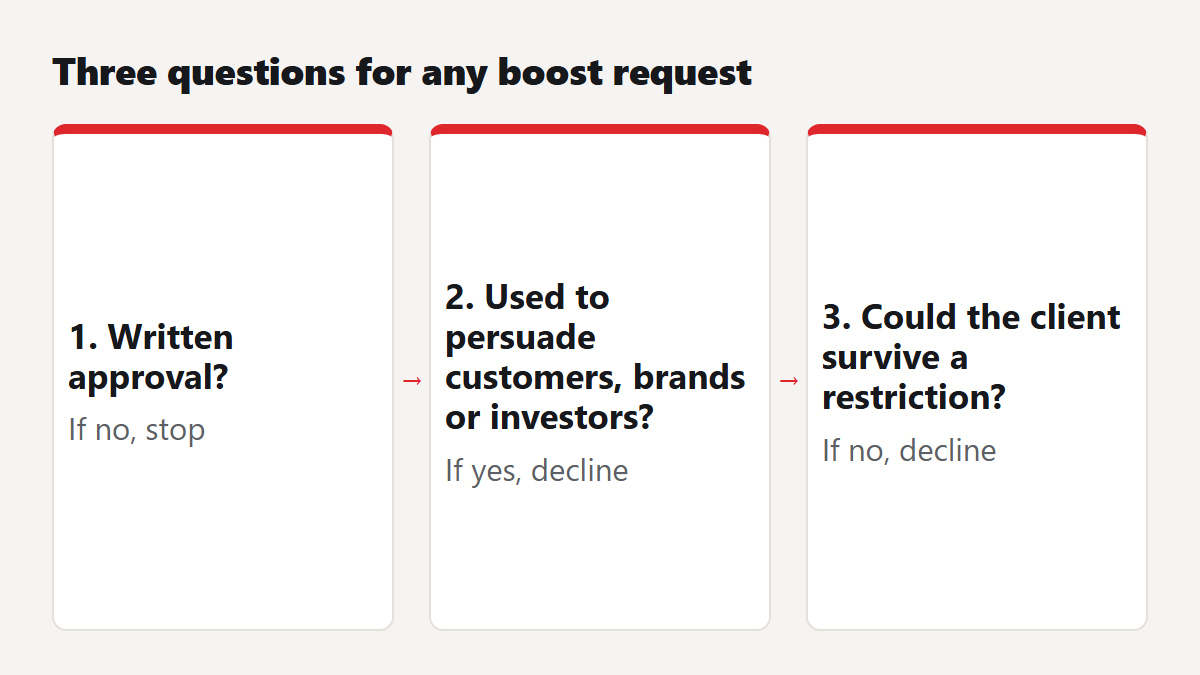
Run any request through these three questions.
- Does the client know, and have they agreed in writing? If not, stop.
- Will the number be used to persuade customers, brands or investors? If yes, decline. That's the misrepresentation problem in its plainest form.
- Could the client survive a restriction on this account? If the account is their main sales channel, the downside is bigger than the benefit.
Few commercial requests survive question two. What's left tends to be small: testing delivery on your own agency's demo account, helping a personal project that isn't selling anything, or a client who's an individual and wants a hobby profile to look less empty. Be honest with yourself about how small that category is.
Requests you should turn down
- Inflating an influencer's numbers before a brand deal.
- Buying reviews of any kind. Fake reviews are banned outright under the FTC rule, and in the UK and EU too.
- Padding a report to hide a bad month.
- Boosting a competitor's account to get it flagged. That's sabotage, and it may well be illegal.
- Political or health campaigns. The stakes are high, and platforms and regulators watch closely.
- Anything for a client who won't sign off in writing.
What to offer instead
Most "can we buy followers?" questions mean the client feels their account looks weak, or they're frustrated by slow progress. Those are real problems, and you can solve them with work you can defend.
| What the client says | What they need |
|---|---|
| "The account looks dead." | A content refresh, a posting schedule and staff or customers invited to follow. |
| "We need followers fast." | A paid follower or reach campaign through the platform's own ads, which is allowed and measurable. |
| "Our rival has 50k." | An audit of the rival. Run their handle through a comparison tool, because a big count with low engagement is reassuring news. |
| "Nobody comments." | Questions in captions, replying within the hour, and a customer community. |
| "We need proof for our site." | A review programme, as in our guide to honest social proof. |
These answers are billable work, and they keep the relationship. Our followers vs ads comparison gives you the budget maths to show a client.
Keep your records straight
If a client has agreed to a boost in writing, treat it the same way as any other media spend.
- Keep the signed approval with the client file. Note what was ordered and why.
- Log the date, service, link, quantity, cost and order reference for every order. The reference is what you'd need for a refill, and it starts with FZ on our orders.
- Record the start count. Our refill policy measures from it, and your report needs it too.
- Show bought numbers as their own line in reports. Don't blend them into organic growth.
- Run one provider per link. A second provider on the same link voids our refill.
- Invoice it as a separate item, so that nobody can say it was hidden.
Practical setup with FollowersZeal
You can check out as a guest, but an agency is better off with an account. You add funds once, place orders across the full catalogue, and see your history in one place, which makes that record-keeping easier. Spending from balance also skips the wait for manual payment confirmation. Refunds for undelivered orders on balance go straight back to your balance, and you can see order status under track order.
No order ever needs a client's password, and you should refuse any provider that asks for one. You hold a duty of care for your clients' logins, and they should stay in your password manager, away from any third party.
A clause for your contract
Adding a short term to your standard agreement makes the conversation easier. Something like: "We don't purchase followers, likes, reviews or similar metrics on your behalf unless you ask us to in writing. We report such purchases separately from organic results, and we'll decline any purchase we believe would mislead your customers." Have your own lawyer check the wording.
That sentence protects you, and it's a selling point as well. Plenty of clients have been burned by an agency that padded numbers, and being able to show them this policy on day one earns trust that no follower count can.
Real, paced delivery for Instagram, TikTok, YouTube and 20+ more platforms — with a free 2-year refill on every order.