Social Proof for a New Online Store: What Works and What the Law Says
How a brand-new shop with no customers can build trust honestly, how to collect your first reviews, and the FTC lines a store must not cross.
A new online store has a chicken-and-egg problem. People want to see that others have bought from you, and nobody has bought from you yet. It's tempting to fix that with invented reviews or inflated follower counts. We sell follower services and we're telling you not to do that for a store, because the law has caught up and the fix doesn't work very well anyway.
There are honest ways to look trustworthy from day one, and they cost little.
The lines you can't cross
If you sell to US customers, the FTC's rule on consumer reviews and testimonials took effect on October 21, 2024. Among other things, it bans:
- Fake reviews and testimonials, including ones written by AI, and buying them.
- Paying for reviews that have to say something positive. You can offer a small thank-you for any honest review, but it can't depend on the rating.
- Reviews from your staff or relatives presented as if they were independent.
- Hiding or removing negative reviews while claiming that the ones on show are all of them.
- Buying fake indicators of social media influence, such as followers or views from bots or accounts not tied to a real person, when you knew or should have known they were fake, to misrepresent your importance for a commercial purpose.
That last point is the one a store owner buying followers walks into. Using a bought number to convince customers that your brand is popular is the commercial misrepresentation the rule describes. The UK and EU have consumer rules on fake reviews too. Take legal advice for your market if you're unsure, and don't count on staying too small to be noticed: competitors, platforms and customers can all report you.
Which proof carries the most weight
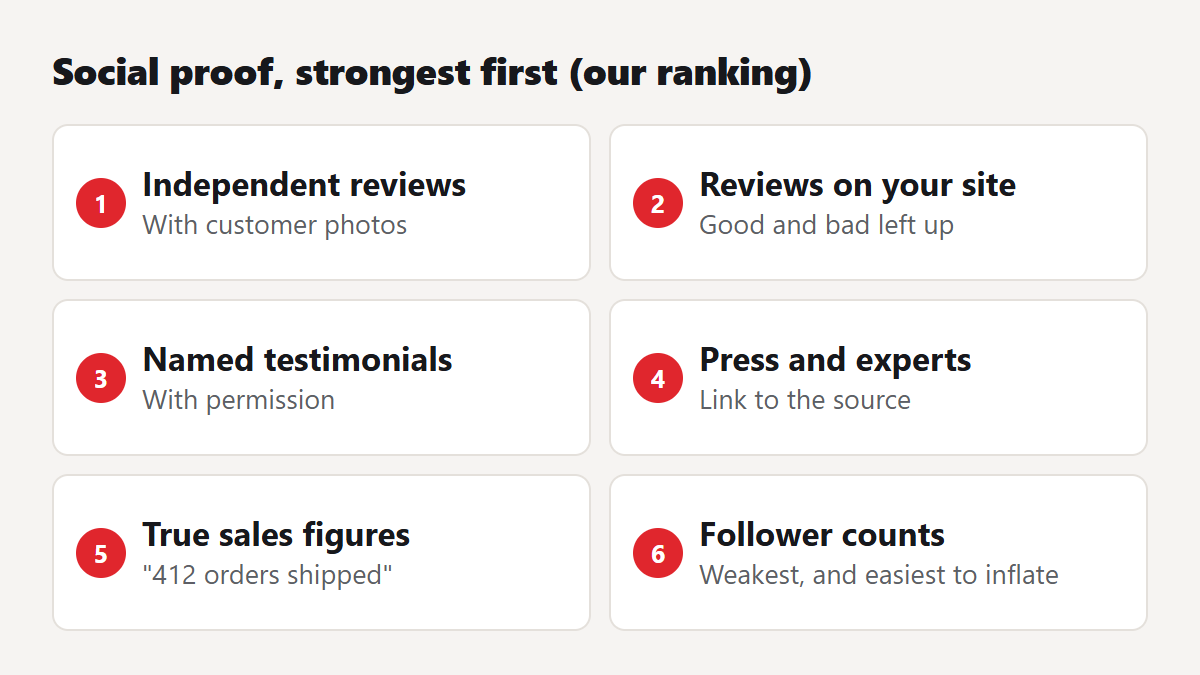
This order is our judgement, based on how hard each one is to fake. A photo from a customer in their kitchen is difficult to invent, and a follower count is the easiest number on the internet to inflate. Shoppers have learned that too.
Before your first sale: trust signals you can add today
You don't need customers for these. Each one answers a question that a nervous shopper is asking.
- A real about page: your name, a photo, where you are, and why you started. Shoppers buy from people.
- A real contact route, with an email address on your domain and a stated reply time. Add a phone number if you can.
- A clear returns policy, in ordinary language, linked from every product page.
- Delivery times and costs on the product page, before checkout. Extra costs that appear at checkout are a common reason for abandoned carts.
- Honest product photos, including one showing scale and one in use.
- Familiar payment options, such as card and PayPal. These bring buyer protection, and shoppers know it.
- A guarantee you can afford. "If it arrives broken, we'll replace it, no photos needed" is worth more than ten star ratings on a new site.
Getting your first 20 reviews honestly
Give products to people who'll be honest
Send a sample to 10 or 20 people in your target audience, in return for an honest opinion and nothing else. Any review they write must make clear that they got the product free. Pick people who'll tell you what's wrong, because you need that too.
Ask every customer, at the right time
Send one short email after the product has arrived and they've had time to use it. Food can be a week, and skincare might be a month. Ask one specific question: "What did you use it for?" Link straight to the review form. Most stores never ask, and asking is what gets reviews.
Collect on an independent site as early as you can
Reviews on a third-party platform or Google Business Profile carry more weight than quotes on your own page, because you don't control them. Set it up before your first order.
Ask for photos
Offer the same small thank-you for any review with a photo, good or bad, and ask for permission to reuse it. One real customer photo on a product page can do more than a paragraph of copy.
Reply to the bad ones
Your first one-star review is coming. Reply calmly, fix the problem, and leave it up. A page with only five-star reviews looks staged, and a fair reply shows future customers how you act when something goes wrong.
Borrowing trust while you're small
Other people's credibility can stand in for your own. If a local paper covers your launch, quote it. If a specialist blogger reviews you, link to it with their permission. Show relevant qualifications, trade memberships or supplier certificates, and list market stalls and shops that stock you. If you sold 200 units at a craft fair, say so. A true small number is better than a vague big one: "412 orders shipped from our workshop in Leeds" feels real because it's specific.
What to do with your social accounts
A new brand's account doesn't need a big follower count. It needs to look alive. A visitor checks the date of your last post far more readily than your total, so post product stories, packing videos and the people behind the shop. Reply to comments. Reshare customer posts, with permission. Twelve good posts and 80 followers looks like a small business. Twelve good posts and 20,000 followers with no comments looks like something else.
Our free account audit tool and social media tools will show you how your accounts look from the outside. Run a fake follower check on any influencer you're thinking of paying, too. Our guide on checking an influencer's audience takes you through it.
Showing the proof where it counts
Put your strongest proof near the place where people hesitate: beside the Add to Cart button, on the checkout page and next to the price. Show the review count with the score, because "4.6 from 37 reviews" reads as more believable than a bare 5.0. Show live numbers only if they're live, since fake "12 people are viewing this" pop-ups are dishonest, and shoppers have learned to spot them.
Spending your first $200
If you had to choose, here's how we'd spend a small launch budget:
| Spend | On | Why |
|---|---|---|
| $100 | Free samples posted to honest testers | Your first reviews and photos |
| $70 | A small ad test | Real shoppers, and proof of which product sells |
| $30 | Good packaging inserts asking for a review | Turns each order into a chance to collect proof |
You'll notice that followers aren't on that list. We sell them, and a store isn't where they belong. For the ad part, our followers vs ads comparison shows what a small budget gets you.
Real, paced delivery for Instagram, TikTok, YouTube and 20+ more platforms — with a free 2-year refill on every order.